
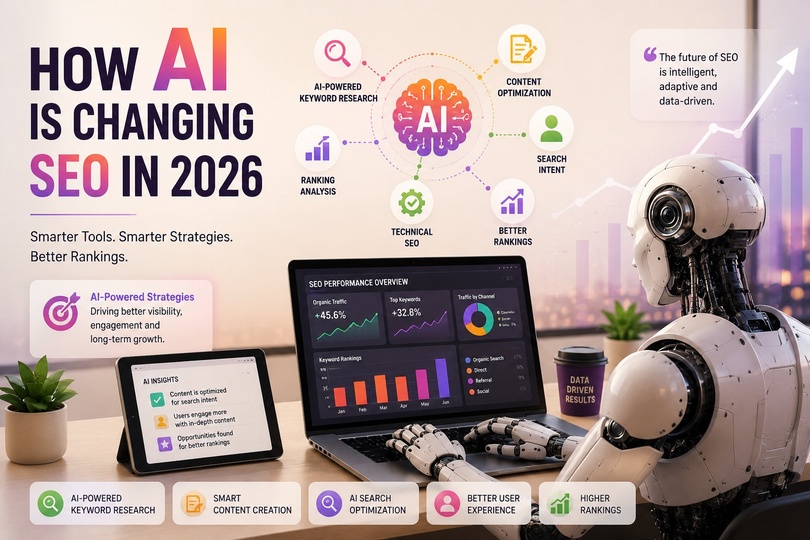
Search engine optimization has evolved significantly over the last few years, and artificial intelligence is now at the center of that transformation. Businesses, marketers, and website owners are using AI-powered tools to improve rankings, create better content, and understand user intent more accurately than ever before.
If you’re wondering How AI is changing SEO, the answer goes beyond content generation. AI is influencing keyword research, technical SEO, search algorithms, user experience, and even how Google delivers search results.
In this article, we’ll explore the latest SEO trends for 2026, the role of artificial intelligence in SEO, and how businesses can use AI-driven SEO strategies to stay competitive in search rankings.
How AI is Changing SEO in 2026?
The question “How is AI Changing SEO” is becoming increasingly important as search engines continue to integrate artificial intelligence into their ranking systems.
Modern AI systems can analyze massive amounts of data, identify search intent, and evaluate content quality more effectively than traditional algorithms. As a result, SEO professionals must adapt their strategies to align with AI-driven search experiences.
Some of the biggest changes include:
- Improved understanding of user intent
- More personalized search results
- Smarter content recommendations
- Advanced keyword analysis
- Automated SEO tasks
- Enhanced content quality evaluation
AI is no longer a supplementary SEO tool—it has become a core component of successful search optimization.
AI-Powered Keyword Research is Becoming Smarter
Keyword research remains one of the most important aspects of SEO, but AI-powered keyword research tools are making the process more efficient and accurate.
Understanding Search Intent
Traditional keyword research focused heavily on search volume and competition. AI tools now analyze:
- User behavior patterns
- Search intent
- Related topics
- Semantic relationships
- Content gaps
This allows marketers to discover opportunities that may have lower competition but higher conversion potential.
Predictive Keyword Analysis
Many AI SEO tools can forecast keyword trends before they become highly competitive. This gives businesses a chance to create content early and gain visibility before competitors enter the space.
For example, AI can identify emerging topics within digital marketing, technology, healthcare, or e-commerce months before they become mainstream search queries.
AI Content Optimization is Improving Search Performance
Content remains one of Google’s strongest ranking factors, but AI content optimization tools are helping businesses create more relevant and user-focused content.
Content Quality Analysis
AI tools can evaluate content based on:
- Readability
- Keyword relevance
- Topical depth
- User intent alignment
- Internal linking opportunities
Instead of simply focusing on keywords, AI helps ensure content genuinely satisfies searchers.
Better Topic Coverage
One major advantage of artificial intelligence in SEO is its ability to identify related topics and questions users frequently search for.
For example, a blog about SEO may naturally include topics such as:
- AI SEO tools
- Google AI search
- AI search optimization
- AI-driven SEO strategies
- Future of SEO
Covering related topics improves topical authority and increases the chances of ranking for multiple keywords.
Google AI Search is Reshaping Rankings
Google continues to integrate AI into its search ecosystem through advanced machine learning models and AI-generated search experiences.
This is one of the biggest reasons marketers are asking, How is AI Changing SEO in today’s digital landscape.
Search Results Are Becoming More Contextual
Google’s AI systems focus on understanding:
- User intent
- Context
- Query meaning
- Content quality
- User satisfaction
As a result, websites that provide comprehensive answers often outperform pages that focus solely on keyword optimization.
This is exactly why strong on page SEO fundamentals still matter in an AI-first search era — comprehensive answers only rank well when they’re built on solid structure.
Experience and Expertise Matter More
Google’s EEAT framework—Experience, Expertise, Authoritativeness, and Trustworthiness—plays a critical role in AI-driven rankings. As a digital marketing consultant in Hyderabad, I help businesses build content strategies that align with all four E-E-A-T signals.
To improve visibility, businesses should:
- Publish accurate information
- Demonstrate industry expertise
- Cite credible sources
- Share real-world examples
- Keep content updated regularly
Websites that establish authority are more likely to perform well in AI-powered search environments.
AI and Content Marketing Are Working Together
The relationship between AI and content marketing has become stronger in 2026.
Businesses are using AI to streamline content creation while maintaining quality and originality.
Practical Applications of AI in Content Marketing
AI can help with:
- Topic ideation
- Content briefs
- Keyword clustering
- Headline generation
- Content optimization
- Performance analysis
However, successful SEO still requires human expertise.
The best-performing content combines AI efficiency with human creativity, industry knowledge, and personal experience.
Real-World Example
A digital marketing agency may use AI tools to identify trending SEO topics and create a content outline. Human experts then add practical insights, case studies, and professional recommendations.
This hybrid approach often produces better rankings than content created entirely by automation.
AI-Driven SEO Strategies for Businesses
Businesses that embrace AI-driven SEO strategies can gain a significant competitive advantage.
Technical SEO Automation
AI can automate many technical SEO tasks, including:
- Site audits
- Broken link detection
- Crawl analysis
- Schema recommendations
- Page speed monitoring
This saves time and allows SEO professionals to focus on strategy rather than repetitive tasks.
Want this handled for you? Check out my Digital Marketing Services in Hyderabad.
User Experience Optimization
Search engines increasingly reward websites that provide excellent user experiences.
AI helps analyze:
- User engagement
- Bounce rates
- Navigation patterns
- Conversion paths
These insights enable businesses to make data-driven improvements that support higher rankings and better customer experiences. this is how AI is changing SEO
AI is no longer just helping businesses analyze data — it is changing how they approach keyword research, content optimization, competitor analysis, and search visibility. Businesses that leverage AI-powered tools can make faster, data-driven SEO decisions and improve their overall rankings.
To explore the latest tools that can help with AI-driven SEO strategies, check out our complete AI SEO tools guide
The Future of SEO in an AI-First World
The future of SEO will likely be shaped by deeper integration between search engines and artificial intelligence.
As AI continues to evolve, businesses should focus on:
- Creating helpful content
- Building topical authority
- Understanding user intent
- Improving website experience
- Leveraging AI SEO tools responsibly
For anyone asking How AI is Changing SEO, the answer is clear: AI is transforming every stage of the SEO process, from research and content creation to ranking analysis and user experience optimization.
Organizations that adapt early will be better positioned to achieve sustainable organic growth in the years ahead.
Conclusion
Understanding How AI is Changing SEO is essential for businesses that want to remain competitive in 2026. Artificial intelligence is improving keyword research, content optimization, technical SEO, and search engine algorithms at an unprecedented pace.
As digital search continues to evolve, understanding What Is ASO and How Does It Work? can help businesses expand their visibility beyond traditional search engines.
While AI tools offer powerful capabilities, long-term SEO success still depends on creating valuable, trustworthy, and user-focused content. By combining human expertise with AI-driven insights, businesses can build stronger search visibility and prepare for the future of SEO.
FAQ Section
1. How AI is changing SEO in 2026?
AI is improving SEO through advanced keyword research, content optimization, user intent analysis, technical SEO automation, and personalized search experiences.
2. What are the best AI SEO tools?
Popular AI SEO tools include Surfer SEO, Semrush AI features, Ahrefs AI capabilities, Frase, MarketMuse, and Clearscope.
3. Can AI replace SEO professionals?
No. AI can automate tasks and provide recommendations, but human expertise is still required for strategy, creativity, decision-making, and EEAT-focused content creation.
4. Does Google allow AI-generated content?
Google allows AI-generated content as long as it is high-quality, useful, original, and created primarily to help users rather than manipulate rankings.
5. What is the future of SEO with AI?
The future of SEO involves greater focus on user intent, AI search optimization, content quality, topical authority, and personalized search experiences.

Tarunkumar Adapa is a Digital Marketing Freelancer in Hyderabad, certified by Digital Scholar, with 1.5+ years of hands-on experience in AI-powered SEO, social media marketing, content marketing, and performance marketing. He helps startups and local businesses across Hyderabad build measurable, results-focused growth strategies.